It takes no capital. It has pricing flexibility. … I need a Moody’s rating and I need a Standard & Poor’s rating, and I can’t negotiate with them.
— Warren Buffett, Fox Business, 2015
Download the Slides Deck: The_Paramount_Advantage
 Listen to the deep-dive discussion – Why Small Investors Beat Warren Buffett
Every business is two forces on two horizons. The A is the toll — the cash it collects now, at a point others must pass through; short duration, money in the present. The B is the wave — the growth that makes tomorrow’s toll larger than today’s; long duration, value in the future. A business is always some arrangement of the two. This piece is about one of the rarest and most desirable arrangements a business can reach, and about the investor for whom it is worth the most. A word first on how the two forces fit, because it is the ground everything rests on. Every business is a dual-duration thing — part A, part B, in some proportion — and the proportion runs along a continuum: a pure toll at one end, a pure growth wager at the other, and most businesses between, their value a composite of near cash and far base. How far the value reaches depends on two durations at once: how long the toll’s short duration persists — briefly for the weak toll, for decades behind a strong moat — and how long the base keeps growing. In a healthy business the A absorbs the B: the toll generates more than the growth consumes, funds the base from within, and overflows the surplus. The direction can reverse — a business can pour its toll into a base that devours it — and that is usually decay, except in the deliberate wager, where a mature company spends its overflow to build an entirely new base, as Alphabet does with cloud and AI. Hold these in mind: the continuum, the composite of two durations, and the toll that should feed the base rather than be eaten by it.
I. The Kinds of Tolls
Tolls are not one thing, and the differences decide everything. At the weak end sits the toll with no moat. The coffee shop on the corner collects a real fee, but anyone may open another across the street, and the margin is competed away. The commodity producer, the undifferentiated manufacturer — these collect, but they cannot defend what they collect. A step up is the one-off toll, re-won project by project: the law practice, the consulting firm, where the demand returns but each mandate must be won again, and nothing accumulates into a base that survives the people who produce it. Stronger still is the protected toll, defended by something that outlives any person — a brand, a network, switching costs, scale. This is the franchise, and it collects for decades. At the strong, recurring end sit two summits, both superb and cash-gushing, and easily confused. The magnificent A is a strong, protected toll whose wave has gone still. Its base is full; the world does not consume meaningfully more of what it sells each year. Coca-Cola and See’s Candies are the pure cases — superb returns on little capital, almost no volume growth left, overflowing their cash because the base cannot absorb it. It is, in itself, a short-duration asset: all its value arrives as near cash, none as a growing base, and holding it long does not change that. This makes it optimal in one hand and ordinary in another. Owned outright — Berkshire with See’s, the professional with his own practice — it is superb: the owner captures all its cash and reinvests it outside the business, compounding in a portfolio rather than in the candy shop, exactly as Buffett put it in 1994, the capital growing without physical growth being in the business. But the minority shareholder captures none of that. He receives only a dividend and depends on management to allocate the rest — a gilded toll whose missing wave he cannot replace with his own allocation, because he does not control the cash. What the full owner turns into an engine, the minority holder is left to watch overflow into other hands. The other summit is the one this piece is about, and it differs in the single respect that decides everything: whether a free wave still runs through the toll.
II. The A Paramount
The paramount is the magnificent A with its wave brought back to life, and made free. To see what that means, look first at how growth is normally bought. In most businesses the B — the wave — costs money: a mechanical B, built dollar by dollar through capital spending and acquisitions, each increment of future revenue requiring a present investment and a human being deciding correctly. Even when it is real, that growth is bought, and bought growth drifts toward its cost unless a moat protects it. Sometimes it is worse — fought for on open ground where others compete it away. A business whose wave is partly free and partly contested has an imperfect B: a flaw in the wave. Alphabet is the case — Search rides in free, but its cloud and AI growth must be won against Amazon and Microsoft, paid for and disputed. The paramount is the rare configuration where none of this applies. Its growth arrives without a dollar and without a decision, carried in by a secular wave its moat captures. Visa does not pay to digitalize the world’s payments: governments push cashless economies, banks install terminals, consumers adopt wallets, and the growth arrives uninvited. The A and the B no longer add; they multiply — A times B. And the perfection is double. Just as a wave can be flawed, a toll can be flawed too — the imperfect A, whose revenue passes only partly through its moat, part protected and part earned on open ground, as with Amazon, its cloud defended while its retail arm is fought in the open. The paramount has neither flaw: a perfect A, whose every dollar passes through the moat, fused with a perfect B, whose growth is wholly free and captured. It is the one business clean on both sides, which is why only five reach it — Visa, Mastercard, S&P Global, Moody’s, and MSCI — and why a business can move toward it by purification: when S&P Global spun off its mobility arm, a bought, mechanical B that did not run through its ratings-and-indices moat, it shed the flaw in its wave and stepped closer to the pure form. The paramount is asset-light by nature, and this is the source of both its gift and its limit. Because others build the base that carries it — the banks, the merchants, the exchanges invest so that Visa need not — its return on capital is extraordinary and nearly all of it is free to leave. But for the same reason its own base cannot absorb what overflows: there is little to reinvest in, so the cash must come out, as dividends and buybacks, and its compounding rate is capped in the low teens rather than the thirty percent it earns. And here is what sets it apart from the magnificent A: it overflows and compounds at once. The magnificent A only overflows — its base is dead, so all its cash must leave. The paramount overflows the surplus it cannot absorb, yet its base still widens modestly on the free wave, so it compounds internally at the same time. It is the only toll that does both. The cap and the overflow are one fact seen twice. One paramount, MSCI, has pushed this to its edge, borrowing to buy back so much stock that its equity has gone negative — in effect building, on the debt side of its capital structure, the reservoir of absorption its light equity base could not provide.
III. The Paramount and the Magnificent A — the Arithmetic
Set the two summits side by side, for they are the ones most easily confused, and the difference is not qualitative but arithmetic. Both earn a superb return inside — call it twelve percent. What a minority shareholder actually captures from each is another matter entirely, and it depends on whether the business can compound that return or only pay it out.
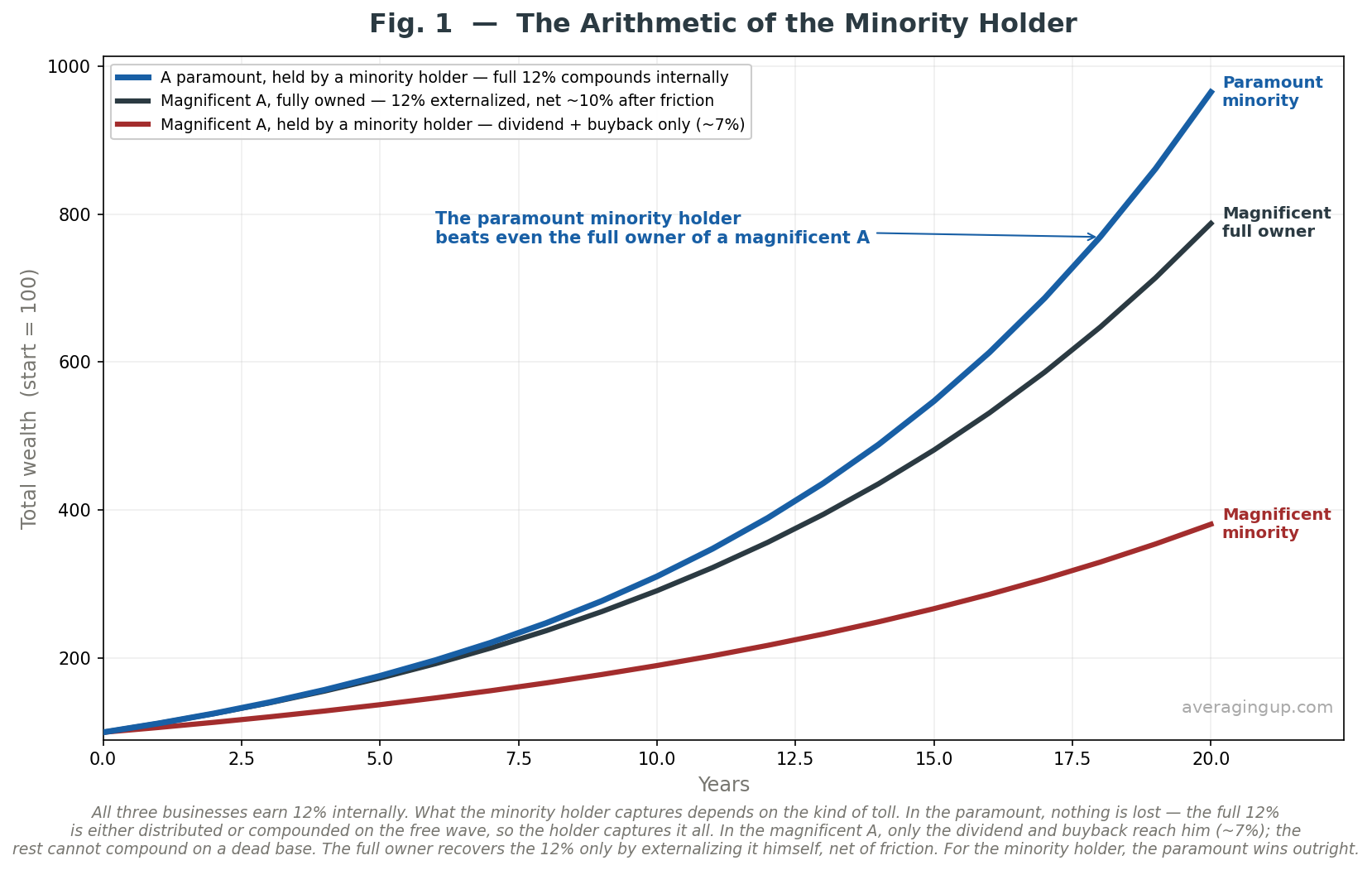
All three cases in the figure earn the same twelve percent inside. What reaches the shareholder depends on the kind of toll. In the paramount, nothing is lost: the full twelve percent is either distributed — as dividend and buyback — or compounded on the free wave, so the minority holder captures it whole. In the magnificent A, only the dividend and buyback reach him, some seven percent; the rest cannot compound on a dead base, and simply fails to arrive. The full owner of a magnificent A recovers the twelve only by externalizing it himself, net of tax and effort. Run the three out, and the result inverts every intuition: a minority holder of Visa, controlling nothing, ends ahead of Warren Buffett owning Coca-Cola outright. Not because he is the better investor — he need not be any kind of investor at all — but because he holds the structure that loses nothing between the business and the shareholder, while even Buffett must pay the friction of moving a magnificent A’s cash by hand. The paramount compounds for you what the magnificent A obliges even Buffett to compound himself.
IV. The Minority Holder’s Three Good Options
That settles the paramount against its cousin. Against its rival — the superb compounder — the comparison is different, and here the minority shareholder has, in truth, three good options, none wrong when chosen well. Set the owner-operator aside — the one who controls the cash and does best with a magnificent A he reinvests himself. For the minority shareholder, who owns a sliver and controls nothing, the question is which kind of business compounds well on his behalf. The first is the delegated dual-duration company — one that reinvests its overflow into new bases, run by an allocator he trusts. Alphabet pours Search’s cash into cloud and AI; Berkshire turns its subsidiaries’ earnings into fresh acquisitions. The minority holder delegates allocation to someone better at it than he is. This works if the allocator is genuinely superior and the new bases earn above their cost — but it is a wager on contested ground, won by someone else. The second is the superb compounder with a wide base — Union Pacific the type, buying its growth but behind a moat that protects the return on it, absorbing large amounts of capital internally. This works if the high internal return truly persists, which is rare and hard to verify in advance; what looks superb is often mechanical, its return drifting toward its cost. The third is the A paramount — and its advantages for the minority holder are the most specific of the three.
V. What the Paramount Offers the Minority Holder
The first advantage is the lowest dependence of the three. The delegated company depends on the allocator; the superb compounder on the durability of a high reinvestment rate. The paramount depends on neither. Its growth is free and arrives without a decision — nothing to deploy, nothing to acquire, no judgment to get right. The upside cannot be mismanaged, because there is nothing to manage. And the independence runs deeper than it first appears. The magnificent A demands allocation at two levels, each carrying its own allocator’s risk and reinvestment risk: the cash it overflows must be reinvested well, and the toll itself, once its wave dies, must eventually be replaced — sold and rolled into a fresh A, or a second one laid over it, because its base does not extend. The paramount demands neither. Its base widens on the living wave, so there is no source to renew; and it compounds internally, so there is no cash to redeploy. For an investor who controls no cash and cannot verify from outside whether a management allocates well, a business that needs no allocation at all — not of its cash, not of itself — is worth a great deal: it asks the least of the people running it, and so the least trust of the person owning it. The second is certainty. The delegated company and the superb compounder are wagers on a future that must prove out. The paramount’s wave is a present fact: eighty-five percent of the world still pays in cash, and every such transaction is a future digital one that arrives whether or not anyone decides anything. Its floor sits higher than almost any equity — a moat built not by the company but by the ocean of transactions passing over it, strengthened by use rather than eroded. The third is free growth that compounds a long time even if it never explodes: sober, in the low teens, capped by the light base — but free, undecided, and running for decades as the wave keeps arriving. A modest rate that compounds free and certain for a very long time, undisturbed, is rarer and safer than a high rate fought for each year.
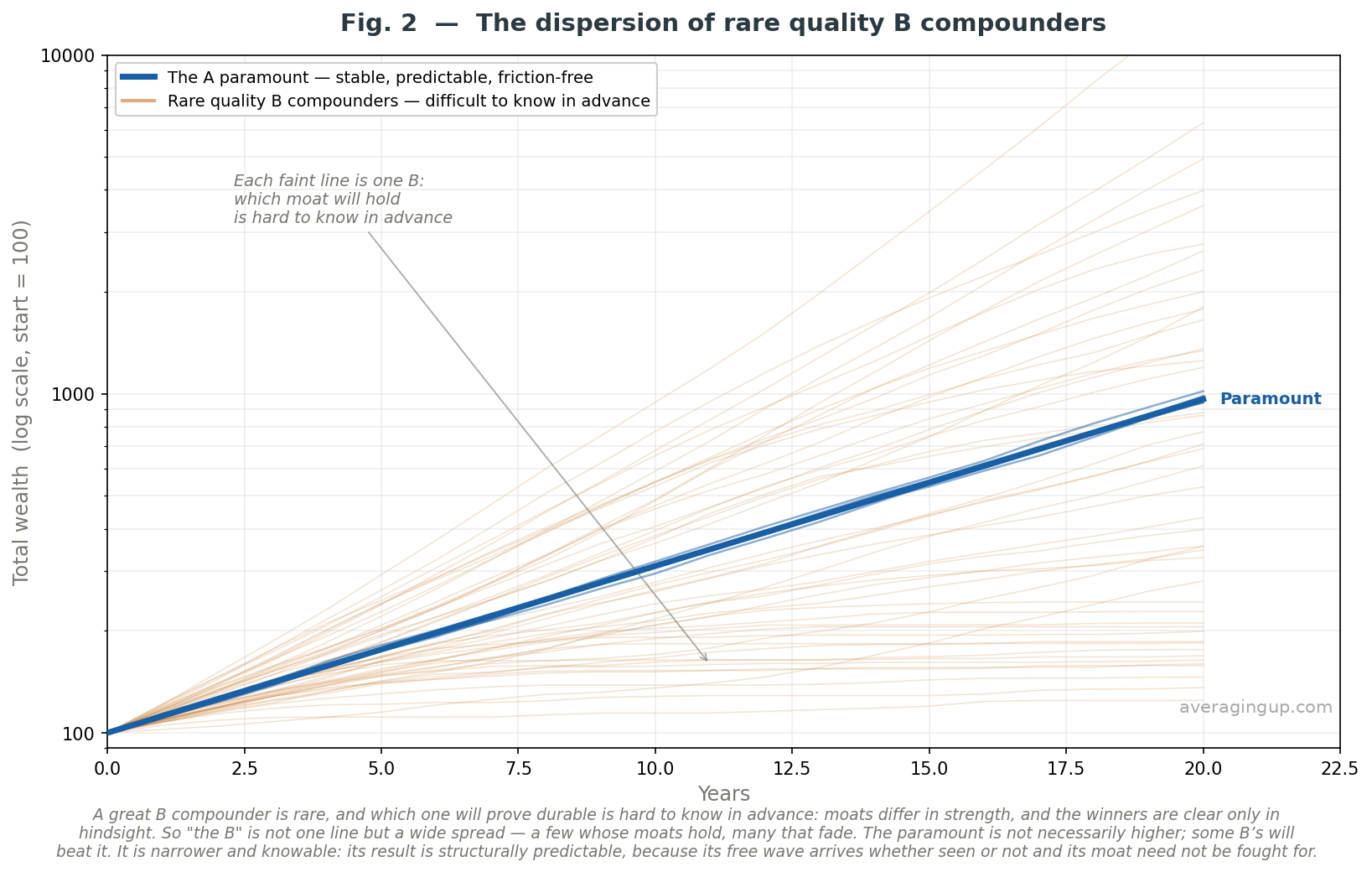
And here the comparison with the superb compounder sharpens. A great B is not a single line but a wide spread of outcomes. A quality B has a moat too, but moats differ in strength, and which one will prove durable is rare and hard to know in advance — the winners are clear only in hindsight. Some B’s will beat the paramount handsomely; many erode toward their cost as their edge fades. The paramount is not necessarily the higher line. It is the narrower and the knowable one: its result is structurally predictable — not because its wave is visible (its best growth is precisely the part the market cannot see), but because that wave arrives whether seen or not, carried by a secular movement and captured by a moat that need not be fought for. Choosing a B is a wager on where in the spread you land; choosing the paramount is choosing a stable, friction-free result in advance. The fourth is a structural undervaluation that rewards patience. The market prices what it can see — the current toll, the visible earnings — and struggles to price a wave that is free, vast, and far off, because a spreadsheet cannot easily value growth that costs nothing and arrives on its own for decades. So the paramount tends to be priced as a fine present business rather than one whose best growth is still invisible and ahead. That gap is a quiet discount the minority holder can own without doing anything.
VI. The Size Problem, and the Small Investor’s Privilege
One thing decides which of these is truly open to you, and it is rarely discussed: how much you have. A very large minority holder has a problem the small one does not. Berkshire, deploying tens of billions, cannot own a paramount like MSCI — a business worth some forty billion — in any size that would matter; the position would be too small to move its needle, and buying enough would move the price against itself. The giant is pushed toward the largest bases, Apple and Alphabet, not because they are best but because they are the only ones big enough to absorb its capital — and its own overflow forces it to keep feeding ever larger bases, and so, in part, to delegate allocation rather than pick the finest small compounder. Buffett’s minority positions grew giant because he did; past a certain size, the most elegant businesses are simply closed to you. The small minority holder has the opposite situation, and it is a privilege he rarely recognizes. He can own any size of business, including the small paramounts and small superb compounders the giant cannot touch. MSCI cannot absorb Berkshire’s capital; it can easily absorb yours. His smallness, which feels like a limitation, is in truth an access the largest investors on earth have lost — he can do what Buffett no longer can. So there is no single best holding, only a best one for each investor. The owner who controls the cash does well with a magnificent toll he reinvests himself. The giant is pushed toward large bases and some delegation. And the small minority holder — most readers, most of the time — holds the widest menu of all, and at its center sits the A paramount: the business that compounds on its own, free and certain, asking no control, no brilliant allocation, no trust in anyone’s wagers, and quietly underpriced because its best growth is invisible. To it he may add, by appetite, a delegated compounder run by an allocator he rates, or a superb small-base compounder he has the rare privilege of being able to buy. None is a mistake. But the paramount asks the least of him and protects him the most — and it rewards, of all investors, the small one best, because being small is not the handicap it feels like. It is the key to the rarest and safest compounding there is.
Watch the Video