You can certainly have a situation where there’s absolutely no growth in the business, and it’s a much better investment than some company that’s going to grow at very substantial rates, particularly if they’re going to need capital in order to grow.
Our capital is growing, without physical growth being in the business.
— Warren Buffett, 1994
Download the Slides Deck: Winning Without Growth
 Listen to the deep-dive discussion – Why Zero Growth Beats High Growth
Modern investing worships growth. A business that compounds its revenue at twenty percent is celebrated; one that barely grows is dismissed as tired, ex-growth, a value trap. Coca-Cola sells roughly the same volume it did years ago. See’s Candies has grown its unit sales at a crawl for decades. By the reigning standard, these are second-rate holdings — businesses whose best days are behind them. The standard is incomplete, and the correction is more interesting than the rule. A high-return business that does not grow can be among the most useful things a portfolio can hold — or among the most disappointing. Which one it is does not depend on the business. It depends on two conditions the business cannot supply by itself: whether its cash is reinvested, and whether you control enough of it to reinvest. This piece is about a single kind of asset — the magnificent A, the strong, high-return toll whose growth is behind it — and about the conditions that decide what it is worth to you.
I. What Growth Actually Costs
Start with the question Buffett posed at the 1994 meeting: would you rather own a business that pays you ten percent a year and never changes, or one that pays two percent a year but grows that payment at ten percent? The instinct is to take the grower. The arithmetic says otherwise, because the ten percent arrives now, while the growth arrives later — and the cash that arrives now compounds while the growth is still on its way. The decisive variable is not the growth rate. It is the rate at which earnings are reinvested, measured against what the cash would earn elsewhere. A business earning ten percent on capital is worth the same whether it keeps that ten percent or pays it out, provided the cash is reinvested at the same ten percent. Keeping and paying are identical at equal rates; the difference appears only when the rates differ. If a company reinvests internally above what the cash would earn outside, keeping it wins — that is the true compounder, and it is rare. If it reinvests below that rate, paying out wins, because the owner does better with the cash in hand. A company that retains earnings to grow at a mediocre return is not compounding; it is destroying value relative to simply handing the money back.
II. How Long Cash Up Front Stays Ahead
The advantage of cash received now is larger and lasts longer than intuition allows. Set the magnificent A — earning and returning ten percent a year in cash, which the owner reinvests outside the business — against a genuine grower: one that starts by returning five percent, a real equity return above a bond, and grows that payment ten percent every year. (The two are parallel holdings, not a system: the magnificent A reinvests its cash at ten percent in some other asset, not in the grower; we are asking which of the two the same hundred dollars should have bought.) By the second decade the grower pays out far more each year than the steady ten. And yet, with all cash reinvested at the same rate, it does not overtake the magnificent A for nineteen years. For almost two decades the business that paid its ten percent up front stays ahead, because the early cash had all those years to compound while the grower’s payment was still climbing toward it.
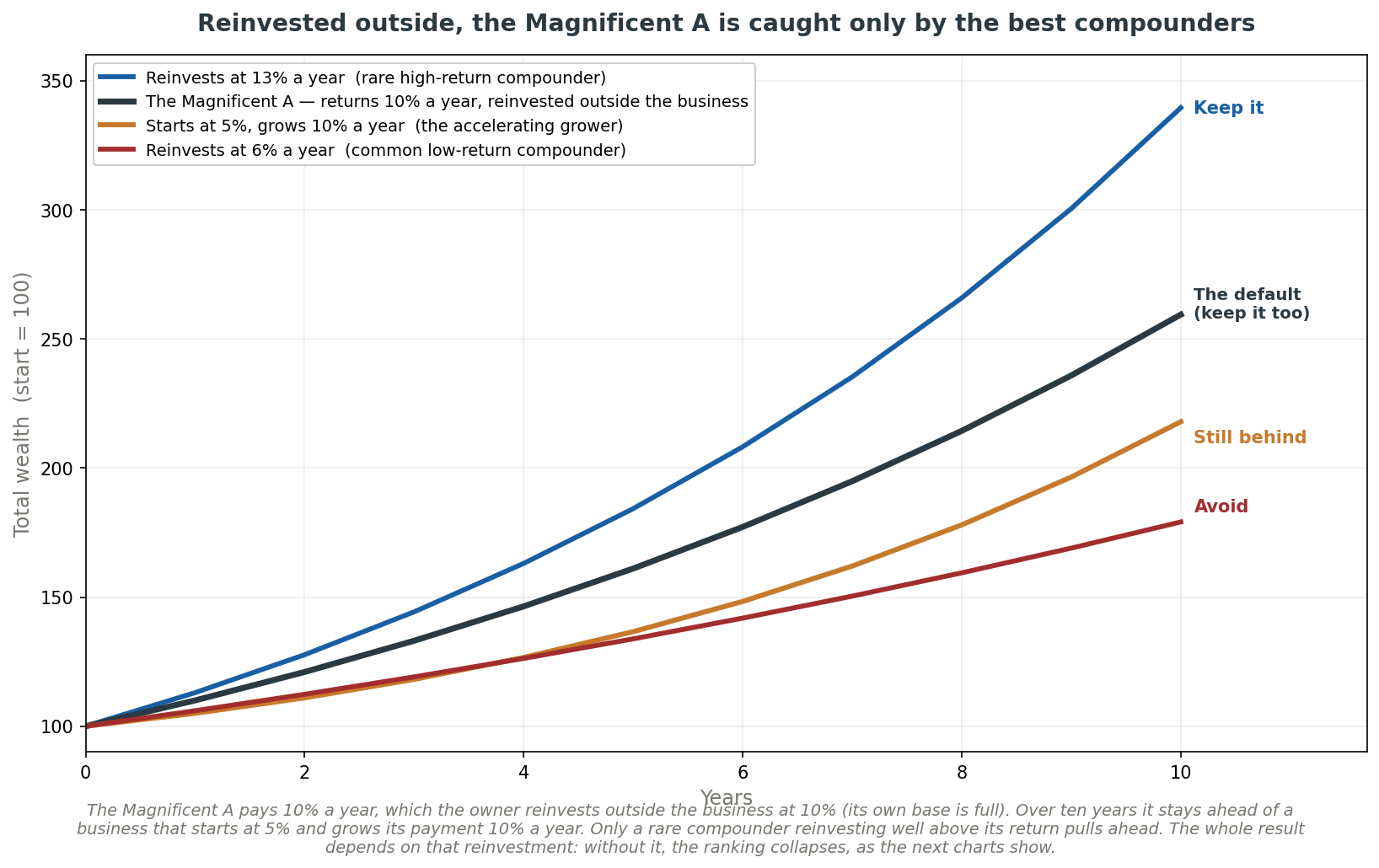
Over the realistic ten-year horizon, the ranking is clear. Reinvested outside, the magnificent A leads every business but one. The common compounder that reinvests below the rate the cash would earn elsewhere falls behind and stays there. The grower, for all its acceleration, is still behind at the end of the decade. Only the rare compounder that reinvests well above its own return pulls ahead, and such businesses are the exception. There is a deeper reading. The ten-year line roughly divides the short duration’s domain from the long’s. The magnificent A is short duration — its cash arrives early. The grower is long duration — its value sits in flows that arrive later. The received belief is that long duration must grow more than short, because it compounds for longer. It does not, on any horizon that matters. The short duration leads outright through its own decade, and keeps its lead through the years beyond, as the assumptions grow fragile. Call it a margin of safety in time: a good asset does not merely win; it wins with a reserve of years before anything can catch it — and that reserve belongs to both the A and whatever B the cash is reinvested in.
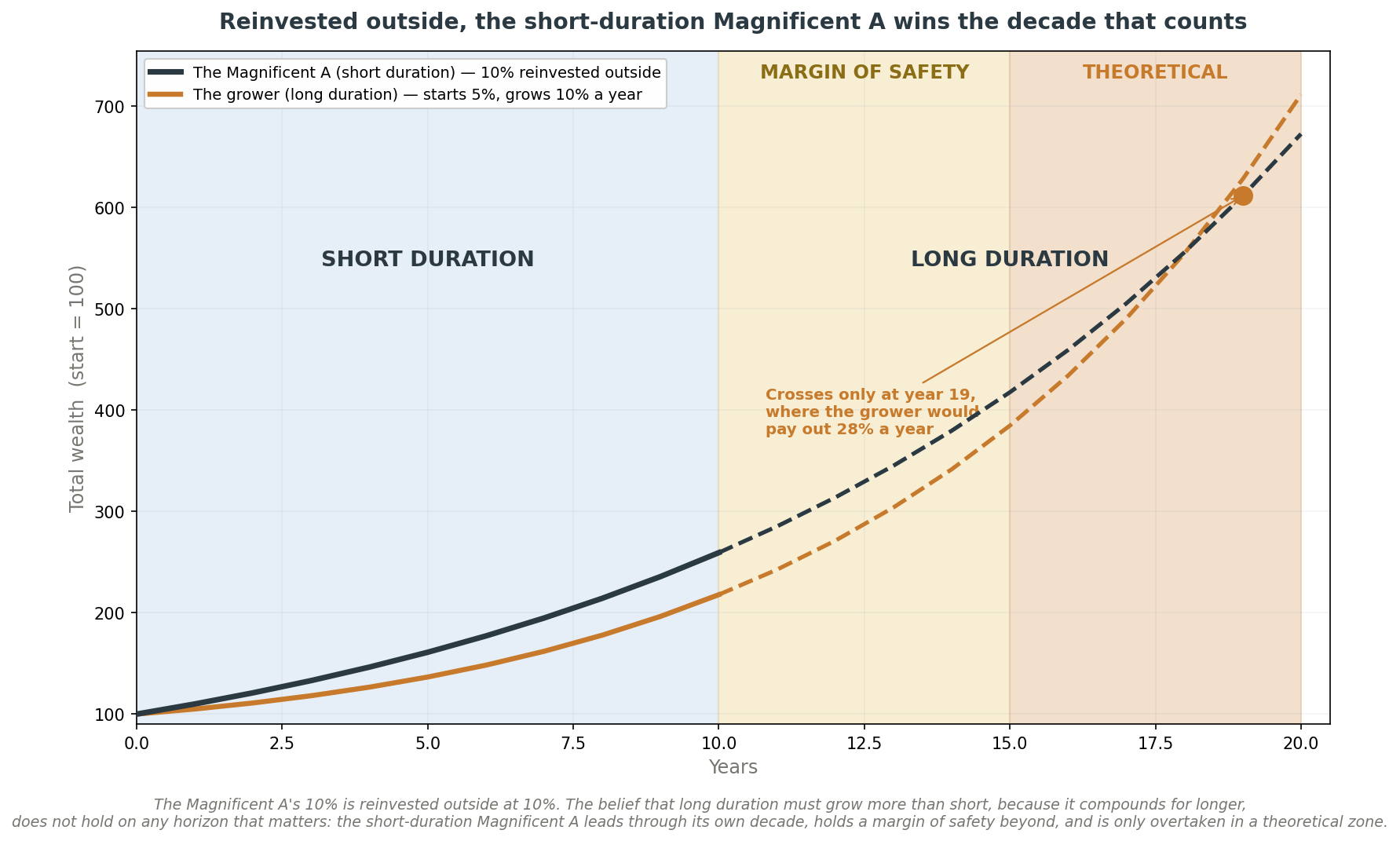
The crossover, when it comes, is theoretical. It arrives at year nineteen, where the grower would be paying out twenty-eight percent of the original capital each year, and only after nineteen uninterrupted years of acceleration. Diminishing returns make such a run unlikely ever to occur; in the real world the grower plateaus or fades long before. The model assumes a smooth, repeating world; the real one is a single rough path. Which is the final reason the cash in hand wins: it is certain and already received, while the grower’s advantage lives in a distant zone the world rarely reaches.
III. The Magnificent A, With and Without Reinvestment
Every chart above rests on a hidden step. The magnificent A does not compound by itself. It pays ten percent a year in cash, flat — ten this year, ten the next, never growing, because it cannot reinvest in a base that is already full. For that cash to compound it must be put to work somewhere that earns a return — and somewhere, necessarily, is outside the business. As a general rule, that somewhere is a compounder returning in the low teens, the sort of long-run result Munger pointed to; now and then the reinvestment catches a rare window of exceptional return, but the base case is a steady redeployment at a sound rate. The curve that makes the magnificent A a winner is not the company growing. It is the owner taking the cash and compounding it elsewhere. Remove that step and the picture inverts. A magnificent A whose cash is collected and left to sit does not compound at all; its wealth rises in a straight line while every compounder curves away above it. Worse, the return on the total capital held — the business plus the idle cash — steadily falls: ten percent in the first year, near five by year ten, below a bond by year eleven, drifting toward nothing after. The headline ten percent becomes an illusion. The asset still earns ten on its small productive base, but the owner earns less and less on what he actually holds. A high return that is never reinvested quietly decays into a low one — fine for someone who simply wants cash to spend, fatal for anyone who believes he is compounding.
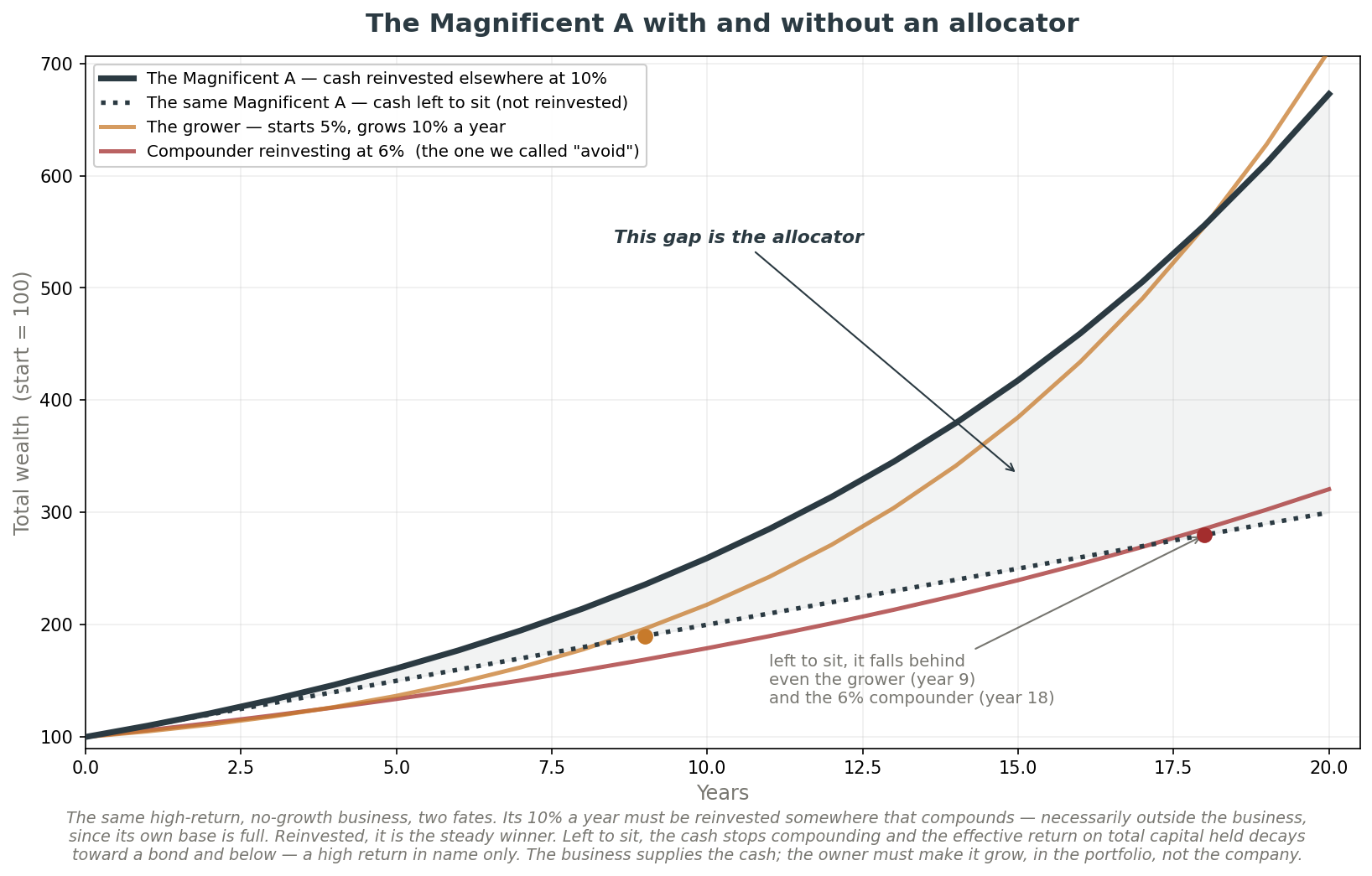
So the thesis must be stated precisely: the magnificent A beats the growers only if its cash can be compounded, globally, outside the physical business. This is exactly what Buffett described in 1994 — the capital grows without physical growth being in the business. The business supplies the cash; the owner must make it grow, in the portfolio rather than in the company. The magnificent A and the allocator are one machine, and neither is worth much without the other.
IV. And How Much You Capture Depends on Control
There is a second condition, quieter than the first and just as decisive: how much of that ten percent actually reaches your hands to reinvest. It depends entirely on how you own the business. Buffett’s 1994 remark was about companies owned outright — where the owner controls one hundred percent of the cash flow and externalizes all of it. This is the world of Berkshire and See’s, but also of the private-business owner, the consultant, the professional who owns his practice and sweeps its surplus into a portfolio. For them the ten-percent model holds in full. The minority shareholder of a listed magnificent A lives in a different world. He does not receive ten percent to redeploy. He receives the dividend — perhaps three and a half percent for a business like Coca-Cola — growing over time as buybacks shrink the share count. A million dollars of Coca-Cola hands him something like forty thousand a year to reinvest, not a hundred thousand; the rest stays inside the company, allocated by management, mostly through buybacks. His outcome now depends on two allocators, himself for the dividend and the board for the retained cash, and he captures far less of the ten percent than the owner who holds the whole business.
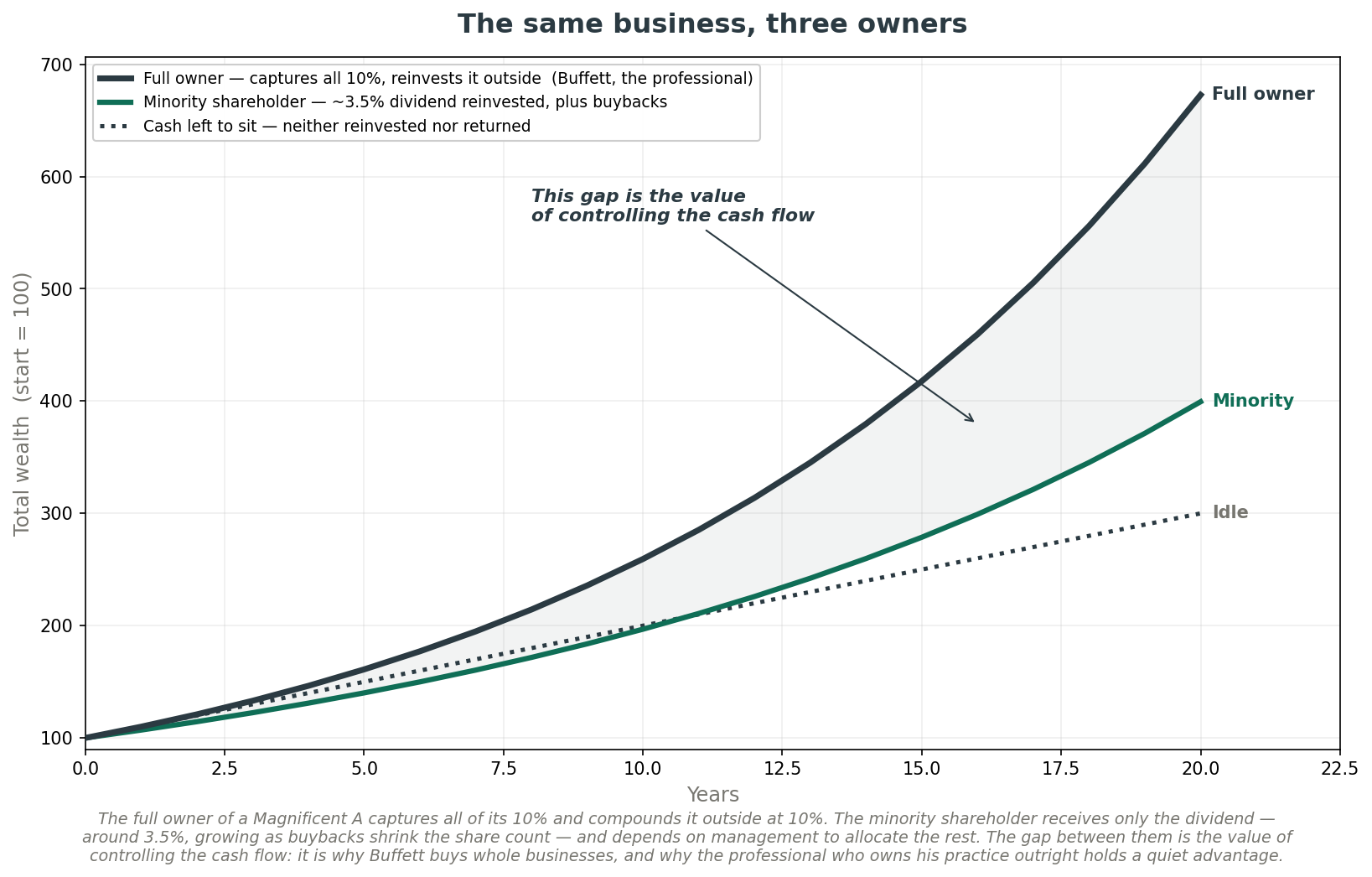
The gap between the two is the value of controlling the cash flow, and it is large. The same magnificent A, over twenty years, builds far more wealth for the owner who externalizes all its cash than for the shareholder who receives only a dividend. This is why Buffett buys whole businesses whenever he can, and why the professional who owns his practice outright holds an advantage he may never have named: he controls the cash, and can send all of it where it compounds.
V. Where the Magnificent A Really Stands
Put every case on one field — the magnificent A owned outright, the same held as a minority position, the same left idle, against a grower and against compounders high and low — and the magnificent A stops being a single thing with a single rank. It becomes a range.
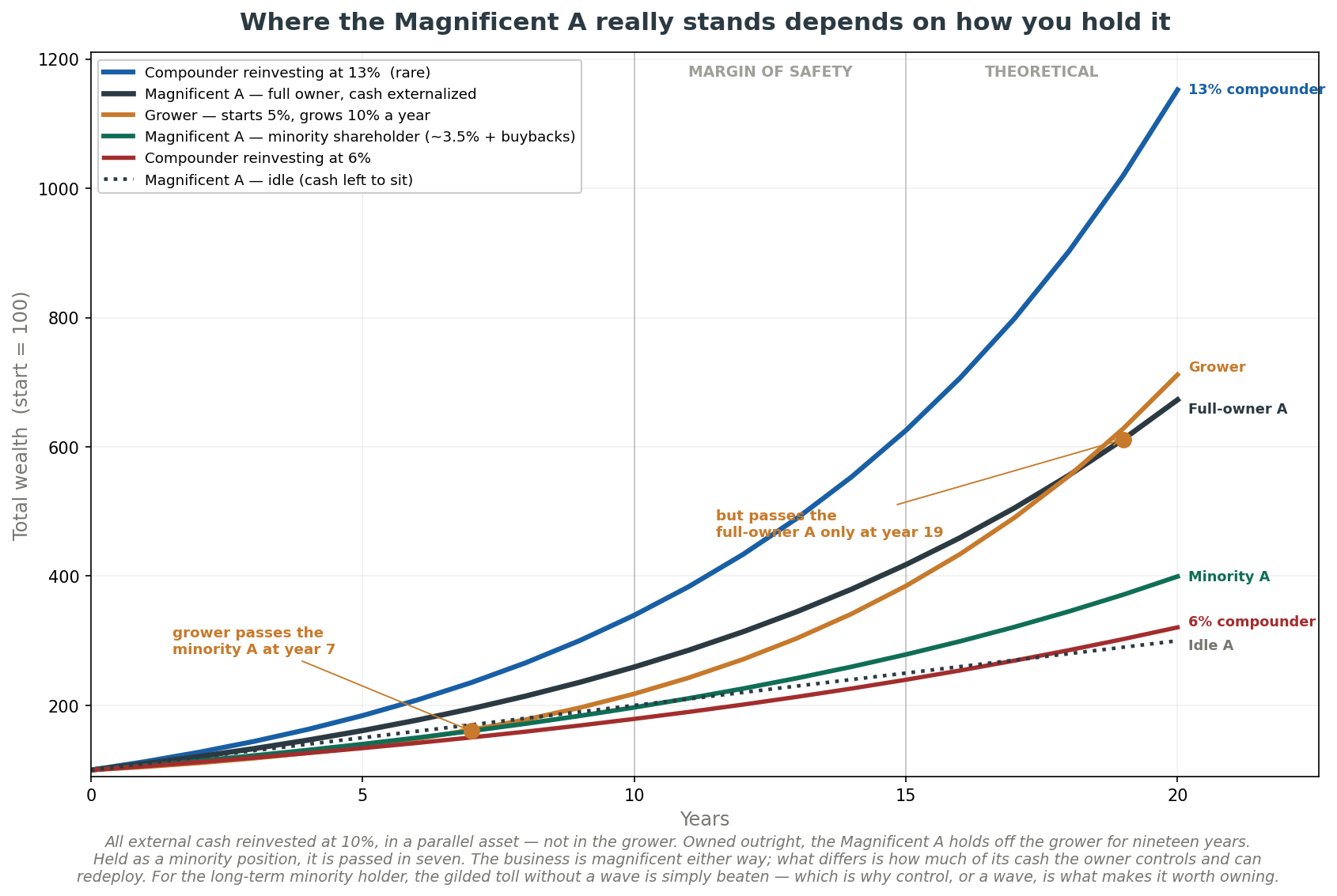
Owned outright and compounded elsewhere, the magnificent A rivals a good grower and trails only the rare high-return compounder — an excellent holding. Held as a minority position, with only the dividend to redeploy, it falls behind the grower and barely beats a mediocre compounder — a fair holding, no more. Left idle, it is the worst of all, beaten even by the business reinvesting at six percent. The company is identical in all three cases. What changes is control and allocation. For the magnificent A, quality is not a property of the business. It is conditional on what its owner can do with the cash. The contrast is sharpest in the timing. Owned outright, the magnificent A holds off a good grower for nineteen years. Held as a minority position, it is passed in seven. Seven years is shorter than most investors hold anything, which carries a plain and underappreciated conclusion: the long-term minority shareholder does not gain by owning a magnificent A. Not because the business is poor — it remains magnificent, objectively, a gilded toll with a wide moat and superb returns — but because its one defining trait, the absence of a wave, is harmless to the owner who controls the cash and decisive to the one who does not. The full owner replaces the missing wave with his own allocation; the minority holder cannot, and is left with a dividend too small to compound past the grower. The same gilded toll is a fine holding for one and a mediocre one for the other, and nothing about the company explains the difference. Only the ownership does.
VI. Where It Fits
So the place of the high-return, low-growth business is not fixed; it is a function of who holds it. For the owner who controls the cash flow and compounds it well, the magnificent A is a superb instrument — a tap of reliable capital that funds every other allocation, matching a good grower and freeing the owner to buy the rare compounder when it appears. For the minority shareholder who can redeploy only a dividend, it is a modest holding, and often a genuine compounder — one that reinvests internally at a high rate — serves him better, because it compounds without asking him to be the allocator at all. One consequence reaches further, and it is the allocator’s real craft. The magnificent A is a source of certain cash, but a source with a finite life — no toll flows undiminished forever. So it is not held so much as rolled: before it ages, its owner sells it and buys a fresh one, renewing the certainty rather than riding a single source into decline, and harvesting in the margin-of- safety years before the projections soften. The growing business is the opposite — a wager kept, not rolled, as long as its thesis holds and carries it toward the long-duration payoff. Renew the source by rule; hold the wager by conviction. Done well, one never lives in anyone’s theoretical zone — which is, in a sentence, what Berkshire has always done. But that is a craft for another piece; here it is enough to see that even the source must be tended. Growth was never the measure of a business’s worth to you. What it returns, whether you control what it returns, and what you can do with it — that is the measure. The business that no longer grows can be the one you most want to own, if you own enough of it to put its cash to work. And if you do not, the lesson is the same seen from the other side: seek the business that compounds for you, from within, so that its growing happens without any physical growth being asked of you at all.
Watch the video